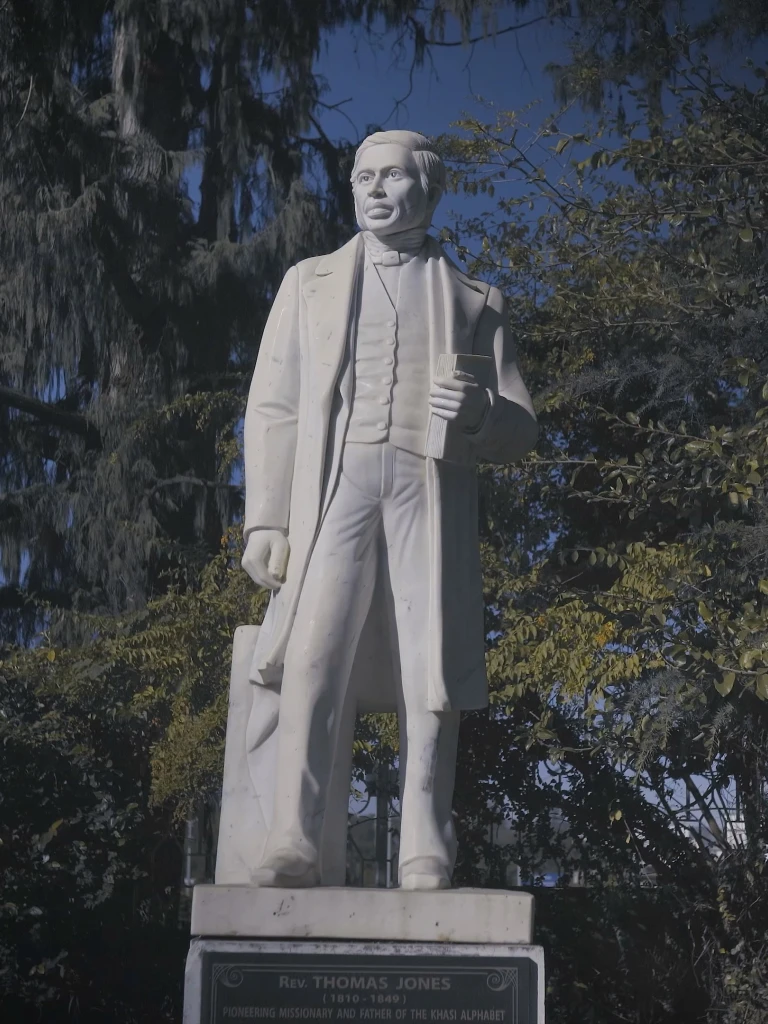
Commemorating the life of a Welsh missionary, Thomas Jones Day is a bank holiday, celebrated on 22 June. But anyone in Wales who wants to mark the occasion might be a little disheartened to learn they’ll have to travel some additional 4,000 miles (6,500km) to the Indian state of Meghalaya to join the celebrations.
The fact that a state in India observes the only public holiday dedicated to a Welsh person anywhere in the world is one of the quirkier bonds connecting our two nations, with further (some might say more conventional) ties to be found across a wide variety of sectors, spanning architecture to music.
From joint university ventures to a shared enduring love for a good game of cricket, here are more of the connections that link Wales and India.
Gwalia in Khasia
In the 1800s, the Presbyterian Church of Wales decided to form an overseas mission to the Khasi Hills region, in the modern-day state of Meghalaya in northeastern India. This has created one of the most longstanding links between Wales and India, that still endures today.
From 1841, around 200 Welsh missionaries visited the region over a period of more than 100 years. While the missionaries’ work led to a demise of local age-old customs and traditions, they did contribute to improvements in education and healthcare, and building schools and hospitals, many of which still receive funding from Welsh sources today. Numerous Presbyterian-style churches were also built during this period. A handful of Khasi missionaries, including Shoshi Mukhi Das and Reverend Rai Bhajur, also visited Wales during this period, giving lectures on the work of the Presbyterian Church of Wales, and undertaking medical training.
While working to spread the gospel, the missionaries in India also inevitably imprinted aspects of Welsh culture onto the local landscape. As a result, visitors to the region will still hear reworked versions of traditional Welsh hymns being sung at Sunday church services.
Another link: the Khasi regional anthem, Ri Khasi, often sung at cultural events, bears the same melody as the Welsh national anthem.
Celebrated Welsh poet Nigel Jenkins visited the Khasi Hills in the 1990s and published a travelogue, Gwalia in Khasia, delving deeper into the region’s historical links to Wales. In more recent years, a number of cultural organisations have aimed to reframe and rejuvenate the relationship between Wales and the Khasi Hills. A notable example is the Khasi-Cymru Collective, a grouping of Welsh and Khasi musicians who released the album Sai-thaiñ ki Sur (The Weaving of Voices) in 2021.
The father of Khasi literature
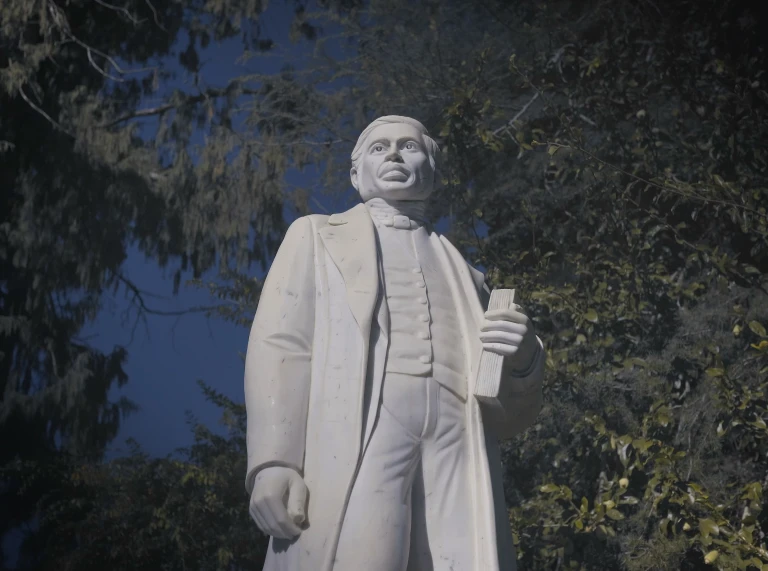
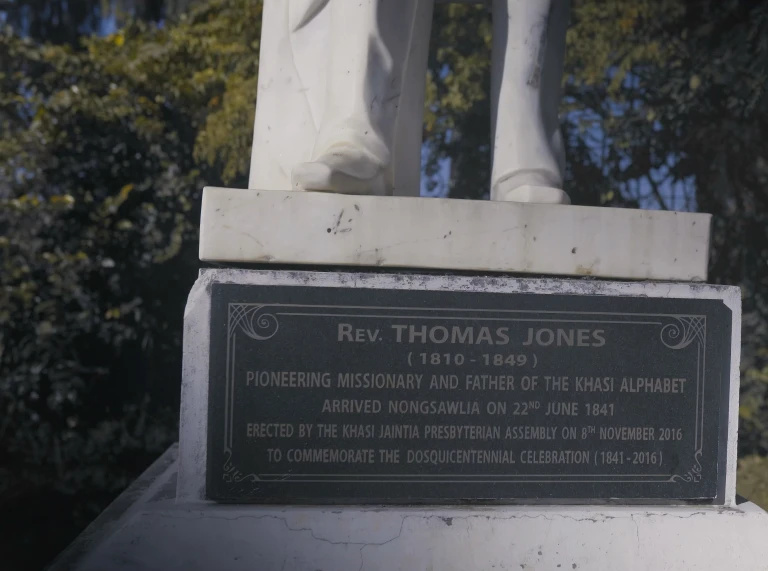
Thomas Jones was instrumental in setting up the Welsh Christian mission to the Khasi Hills and was the first Welsh missionary to travel to the region in the 1840s. In hopes of making himself a more effective preacher, Jones learnt the Khasi language, and went on to create the first written form of the language, with Jones basing the Roman script on the Welsh system of spelling and punctuation.
It’s for this reason that Jones is remembered today as the “founding father of the Khasi alphabets and literature”, a phrase etched into his gravestone in the Scottish Cemetery in Kolkata. Numerous statues of Jones can be found around the Khasi Hills region and, in 2018, the state of Meghalaya announced that 22 June, the date of Jones’ arrival in the Khasi Hills, would be commemorated as a national holiday in six districts. This makes it the first national holiday dedicated to a Welsh person anywhere in the world.
An Indian temple designed in Wales
When a public trust in the Indian state of Karnataka was seeking someone to design a new Hindu temple in the ancient Hoysala style, their search took them in a surprising direction – namely to the Welsh capital city, Cardiff.
It was here that the trust found Adam Hardy, a Professor of Asian Architecture at Cardiff University, who has studied Indian temple architecture for over 35 years.
After accepting the assignment, Professor Hardy spent eight years designing a temple that would resemble those built in Karnataka during the rule of the Hoysala Empire from the 11th to 14th century. Construction of the temple began in 2017 and will likely take over a decade to complete. Once finished, the structure, which will be constructed from blue-grey carved soapstone and stretch to over 30 metres (100ft) in height, is hoped to become a new spiritual focal point in the region, providing a setting for music and dance performances, while welcoming thousands of worshippers and tourists every year.
Supporting education
Building on these ties with the state of Karnataka, Global Wales created a fund enabling institutions in Wales to work more closely with educational facilities in the state, strengthening academic ties, supporting joint research, and facilitating knowledge exchange across borders. Some of the winning partnerships include:
- Aberystwyth University / B R Ambedkar School of Economics University (BASE): a pilot developing a gender‑aware policy framework to analyse firm‑level climate change adaptation.
- Bangor University / Mangalore University: co‑designing an internationally collaborative Philosophy, Politics and Economics (PPE) pathway.
- Cardiff University / Rani Channamma University: development of CyberSafe, an online repository containing digital tools, training modules, and practical interventions to help reduce and respond to online crimes against women and children.
- Cardiff Metropolitan University and Karnataka University: a strategic research partnership focused on AI‑ and machine‑learning‑enabled cyber‑security frameworks for emerging 6G communication networks, supporting critical sectors such as healthcare, smart cities, and industrial automation.
- Swansea University / Vijayanagara Sri Krishnadevaraya University (VSK): a targeted initiative to pioneer advanced materials for defence applications, working on next‑generation lightweight, flexible EMI‑shielding materials.
- University of South Wales / Rani Channamma University: a project exploring the recovery of critical metals from e‑waste, including lithium‑ion batteries and circuit boards, converting them into functional materials for clean‑energy applications.
- University of Wales Trinity Saint David / Davangere University: a collaboration to advance public health through digital transformation, examining health data analytics and AI‑driven healthcare solutions.
- University of Wales Trinity Saint David / Mangalore University: a research‑exchange project examining cloud computing security, data breaches, and network vulnerabilities in modern digital infrastructure.
A love for cricket
Cricket is synonymous with India. It’s the nation’s most popular sport, played in all corners of the country, from carefully manicured pitches to traffic-clogged market streets. But the game also has an impressively long lineage in Wales, with one of the first recorded matches taking place between two teams of local clergymen in Carmarthenshire way back in 1783.
The first time India’s national men’s cricket team played in Wales is believed to be in 1932, as part of the side’s second ever tour of the UK. The three-day match took place at Cardiff’s Arms Park stadium (now the home of Cardiff Rugby) and ended in a draw. Indian teams have visited Wales numerous times since then, always generating a carnival-style atmosphere in the stands, fuelled by great support from Wales’ own Indian communities. In 2026, the India men’s national team will return to Cardiff for a one day international against England, a fixture that sold out faster than any previous international match in Wales outside of the Ashes series.
South Wales-based side Glamorgan, the only Welsh cricket team that plays in the first-class English county championship, also has its own strong links to India, with a number of Indian cricketing legends turning out for the team over the years, including Sourav Ganguly, who captained the Indian national side, and Ravi Shastri, who went on to coach the Indian men’s team. Shastri, who was made an honorary fellow by Cardiff Metropolitan University in 2024, joined Glamorgan in 1987. He spent four seasons in Wales. “I felt at home in Wales,” Shastri has said. “My time there changed my life and I have some great friends there still.”

The Welshman who documented Indian history
A linguistic prodigy fluent in at least eight languages, William Jones was born in London but identified as a Welshman due to his family ties to the country (his father was the celebrated Welsh mathematician, William Jones). Both of these aspects of Jones’ character were highlighted during a meeting with the king of France, where he was introduced by the British ambassador as ‘a man who knows every language except his own’ (meaning Cymraeg, or Welsh).
A lawyer by trade, he moved to the Indian city of Kolkata in 1783 to take up a position in the Bengal Supreme Court. A year later he founded the Asiatic Society, an organisation dedicated to the study of languages, literature, philosophy and history in India and throughout Asia. The organisation, which remains headquartered in Kolkata and is heralded as an “Institution of National Importance”, improved western understanding of Asian cultures and worked to preserve important ancient manuscripts and documents.
Jones was also among the first to conclude that the classical languages of India and Europe likely originated from a common ancestor – perhaps why some linguists have noted a commonality between the Welsh and Indian accents today. And you can even spot similarities between some words of Cymraeg and words of Hindi.
A year-long celebration of cultural ties
In 2024 the Welsh Government launched the Wales in India campaign, a year-long initiative that aimed to showcase our two nations shared history and cultural ties, while working to form new bonds in sectors such as the arts, education, health, business and human rights. The initiative saw 12 months of events in both Wales and India, ranging from large celebrations to small, intimate acts of cultural exchange.
As part of the campaign, Wales became one of the Country Partners for the 25th edition of the Hornbill Festival, a 10-day fiesta in the Indian state of Nagaland that celebrates the diverse traditional cultures of the different indigenous communities within the state, through music, dance, food and ceremonies. As part of the 2024 festival, two Welsh folk singer-songwriters, Gareth Bonello and Mari Mathias, took to the stage, alongside a packed line up of Naga performers.
Other events in the initiative included Wales participation in the Cricket Over-60s World Cup, held in Chennai (where the Welsh team enjoyed a famous win over the hosts!), and a party to celebrate St David’s Day in Mumbai, complete with Welsh cakes baked by a local chef. The beginnings of a new food trend in the global culinary hotspot, perhaps? We can dream…